Friday, April 16, 2010

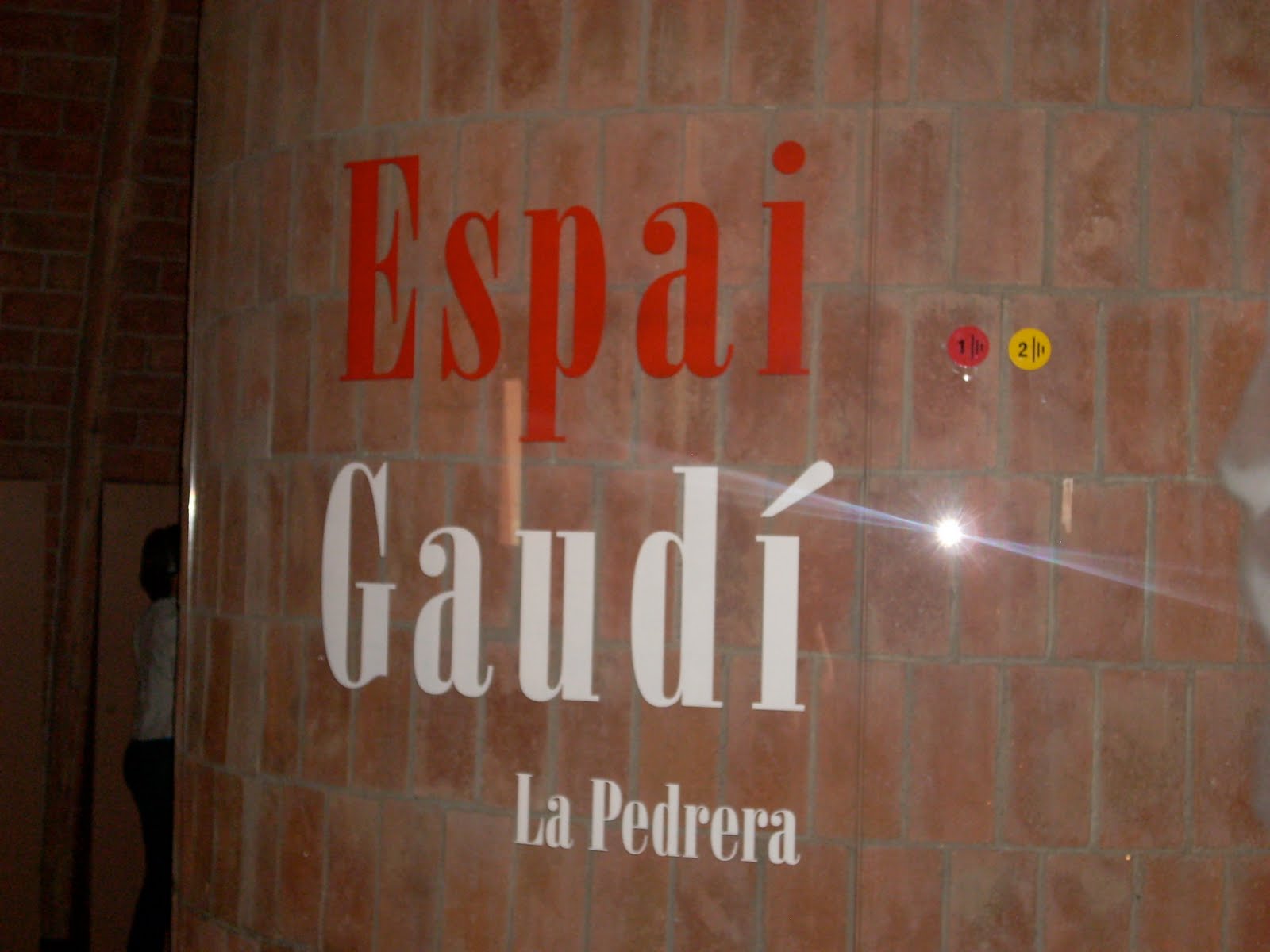
Espai Gaudí La Pedrera: March 12, 2010

La Pedrera is also known as Casa Mila and was designed by Antoni Gaudi. It was built during the years 1906 to 1910, but was officially completed in 1912. It is located on Passeig de Gracia in the Eixample neighborhood. The house that Gaudi built was for a married couple, Rosario Segimon and Pere Mila. The local government objected to some of the design aspects from Gaudi. The height of the building was exceeding the city standard while they also refused to approve the huge sculpture on top of the building.

The buidling has a very unique outside design. It is hard to imagine that someone actually lived inside there because of the amount of detailed work that has been put into building it. The building is almost as if a cliff like rock with caves. From the outisde, there are balconies with iron waves. The interior of the apartment gives an idea of how it must have looked during the 20th century. Just like the outside, the inside has virtually no straight lines. Each room has its own character while the attic shows Gaudi's works including photos and scale models of his buildings. By far my favorite part of the building is the roof terrace. It features several surrealistic colorful chimneys that look like something from a science fiction movie. The view is extraordinary as you can see over the entire district. Although Casa Mila was built in the early 1900s, I was surprised at how modern the house was inside and outside.

The inside of the apartment and each room has been preserved with original halls, drawing room, dining room, bedrooms, bathrooms, etc. There are 5 floors including the main floor that all have common features. The main services, bathrooms, and kitchens are located around the courtyards while the sitting rooms, dining rooms, and bedrooms are close to the facades.

Wednesday, March 3, 2010

Roman Barcino: January 28, 2010

For one of our field trips, we walked what was considered the hub of Roman Barcelona, known then as Barcino. The entrance to Barcino is on the right hand side of the cathedral where a series of artistic sculptures stood. These scultures indicate when you have reached the ancient city. The center of the city was the forum which was a space for commerce and meetings. The forum area was located in Plaza St. Jaume where the council and local government buildings are still positioned today.


Most of the ancient city is now buried deep underneath today's city center. What has been dug up can be viewed in the City History Museum located in Plaza del Rei. A lift goes down into the vaults of the city while a digital year display counts down time in big red flashing numbers. The doors open at 600 A.D. You can see sections of the Roman wall, foundations of buildings, churches, and bathing areas. There was a short film that shows a graphic representation of Barcino, and its geographical location in relation to the rivers and the sea.


I found it interesting to see all of the Roman ruins and how it has transformed Barcelona into the city it is today. Although few of the buildings have been renovated, there are still many that have been there since Roman times. It was a unique experience walking through the dark alleyed streets where so much history exists. Behind the cathedral you could see the Roman walls which were taller than I expected.


Monday, March 1, 2010

La Paradeta: February 24, 2010

La Paradeta is a marisco (seafood) restaurant with a unique style of ordering. The fresh, quality seafood is caught by the restaurant´s own boat and then displayed as if in a fish market, ready for you to choose exactly what and how much you want to eat. I felt as if I was in La Boquería. What is great about this place is that you can see the quality of seafood you are buying before you even sit down to eat it. It has a relaxed-café style that Spanish and Catalans do so well. So you would think that this process would be an expensive meal, right? Wrong. It was actually very fair and reasonable as you pay by weight.

So how does the process work? There is a selection of seafood ranging from crabs, prawns, squid, lobsters, mussels, clams, oysters, and more. You pick out what you want at the counter, it´s weighed up and heaved away, and you pick it up crisp and steaming on a platter. Once you choose what food you want you proceed to the next station where you tell them what you would like to drink. Lastly, you pay for everything, take your number, and wait for them to call it over the microphone. Once our number was called, I began to indulge in the mussels, clams, fried calamari, grilled calamari, and lastly grilled prawns. By far my favorite was the fried calamari and mussels. They were unbelievable!
This concept is loads of fun, but remember to order everything at once so you don´t have to wait in line again. It is especially busy on the weekends. La Paradeta has 3 locations in Barcelona. We went to the one next to the Sagrada Familia which was nice because I had yet to see it light up at night. I found out about the restaurant by doing research on places to take my father while he was here visiting. After reading about it, I thought it would be an interesting experience and a fun way to have dinner. This is truly a seafood lover´s dream.

Museo d´Historia de Catalunya: February 17, 2010

For my Spanish Civilization and Culture class, I visited the Museum of Catalan History to understand the heritage and identity of Catalonia. The museum narrates a story beginning with ¨The Roots¨and ending with the ¨Retrat de la Catalunya contemporània¨. I typically am not a huge fan of museums, but this particular one was quite interesting. The way it was set up was as if you were walking through the history of Catalonia. The maps, pictures, and artifacts brought the story to real life which made it more interesting and easier to understand. It´s remarkable to think that a single region of Spain has so much history behind it. Also, it explains how Barcelona came to be the capital of Catalonia.

The Roots began with the most remote era in prehistory, the Lower Palaeolithic period. The spread of agriculture and husbandry changed the shape of the land and led to the emergence of new cultures. Greek and Phoenician societies in the 7th century BC led to the development of Iberian culture which is one of the most important civilizations of the western Mediterranean. By the end of the 5th century, the defeat of the Western Roman Empire paved the way for the Visigothic Kingdom.

In 711, the Muslim army began its conquest of the Visigothic Kingdom and a new country,al-Andalus, came to exist. Al-Andalus bordered the Catalan counties, which were part of the Hispanic March, the frontier territory of the Carolingian Empire. At the end of the 10th century, the Catalan counts became independent from the Franks, with the House of Barcelona as the dominant family of counts. A phase of economic growth began in Catalonia, though the struggle between the Hispanic monarchy and France led to constant border conflicts. By 1830, Catalonia began to industrialize.

During the first 30 years of the 20th century, Catalan industry went through a period of diversification, characterised by the spread of electricity and oil products. By 1959, the opening up of the economy led to major economic and social changes: foreign capital came into the country; industry diversified; tourism developed; waves of immigration from within Spain occurred; and the consumer society became established. The death of Franco meant the return of self-government and the governing institutions of Catalonia. With so much history in Catalonia, it is now clear why there is so much passion and pride for its region.

Sunday, February 28, 2010

El Gimnasio: January 31, 2010

There was no way I was going to study abroad for 3 1/2 months and not find a gym. Our program CEA had a special deal with a gym called Holmes Place. So my friend and I decided we had to join. Before arriving to join I had no idea what to expect. How would the gyms in the U.S. compare to those here in Spain? Surprisingly the gym was extremely nice and had really great equipment. There was a swimming pool, cafe, wi-fi area, sauna, several treadmills, weights, and much more. Being in a great city like Barcelona with so much to do it would be easy to forget about working out and staying in shape. While at home I had a consistent schedule of going to the gym. Here it is difficult to find a routine with school during the day, going out at night, and traveling on the weekends.

My first time at the gym was an experience. All of the weights are in kilograms which was different than the United States. I had to test everything before I lifted it not knowing how much I was lifting. I soon learned that you multiply the weight in kilograms by 2.2 to get the weight in pounds. Also, the gym attire in Barcelona is very different to that in the United States. The men here wear very tight clothing some would call spandex. Also, there is a particular individual who is always at the gym when I am there wearing very short jean shorts with a tight t-shirt. First of all, I do not understand how that is comfortable to work out in. Secondly, the guy is by no means a small man. He is actually quiet large. It is rather disturbing to look at, but there's nothing you can do.

All kidding aside, I am really glad that I can continue going to the gym here in Barcelona and make time for everything else in my schedule. Not only would I be scared of what I would look like after my abroad experience of not working out, but I would probably be so weak that I would never hear the end of it from my friends. Not to mention if I continue to eat the way I have been lately it wouldn't be pretty. It's nice that I can take something that I enjoy doing at home and bring it to Barcelona. Doing things that make you feel as if you are home helps get over the idea of culture shock which I luckily have not really experienced.

Nightlife in Barca: January 24, 2010

The nightlife in Barcelona is something that everyone at one point in their life must experience. It is truly incredible. In addition, it draws no comparison to anything else I have experienced in my life. There is so much variety in the city that there is something for everyone. From bars to clubs, there is no way you can be disappointed. Before coming to Barcelona, I heard about the social lifestyle here. How people don't go out until 2 AM and if you are at a bar/club before 2 AM you're considered early and very few people will be there. Most bars close around 3 AM while clubs close at 6 AM. The thought of this lifestyle for 3 1/2 months while studying in Barcelona was insane. How anyone could survive was beyond my imagination. This was just for the weekends like Thursday, Friday, and Saturday night, right? Wrong. Who knew that one of the most popular nights to go out would be Monday night? There is honestly someplace to go every night of the week, but there is no way my body or liver would be able to handle 7 nights a week of partying. So to compromise, most people take Sunday and Tuesday nights off. This is honestly the city that never sleeps.

So where are the hot spots you may ask. There are tons. Sure some clubs are more popular to go to on certain nights, but on any given night you could have a choice of 7, maybe 8 clubs to choose from. There's Otto Zutz, Broadbar, Duvet, Sutton, Razzmatazz, Oshum, Catwalk, CDLC, Opium Mar, Shoko, Chupitos, Dow Jones, and many more. Some of the most famous DJs from around the world travel to Barcelona to play at several of these clubs. Many places have more Catalans than others depending on the night and the club. Razzmatazz is a personal favorite of mine because it has 5 floors with different music playing on each floor. Chupitos is a fun bar that has tons of different types of shots. They light shots on fire which I have never seen before.

By going to all of these amazing places there is a price to pay. Drinks at these clubs/bars are crazy. A typical mixed drink can run you anywhere from 6 Euros to as much as 12 Euros. A shot is anywhere from 3 Euros to 5 Euros while a beer could cost 5 Euros to 7 Euros. So even though you may be having the time of your life, the hole in your wallet is probably getting deeper and deeper. The great thing about the nightlife in Barca is that every night is a new experience. Even though you may be going to a bar or club that you have been to before, your experience will be different each time you go.

FC Barcelona vs. Málaga: February 27, 2010

Ever since I have gotten to Barcelona, I have wanted to attend an FC Barca game. Being a huge sports fan, I have followed FC Barcelona for many years and I was finally going to have the opportunity to see them play at Camp Nou. This was also special because my father was in town visiting for the week so my friends and I went to the game with my dad. With my Sport and Culture class, we went on a tour of Camp Nou which was my first time at the stadium. It was incredible. I was amazed at how huge the stadium was. It is the largest stadium in Europe and holds over 98,000 people. We got to look at the visitor's locker room, the field, the media room, the trophy case, and finally the museum.

My second time to the stadium was going to be for the game which would be a completely new and different experience. My friends and I bought FC Barcelona jerseys specifically for the game. Each of us bought a different jersey. There was one Messi, one Henry, one Xavi, and one Ibrahimovic. About four hours before the game, me, my friends, and my father went for tapas and drinks in Plaza Catalunya. We ordered tons of tapas and they brought us a liter mug full of San Miguel. It was amazing. After a couple beers it was time to head to the game. We caught the metro at Catalunya and took it to Maria Cristina. The metro was packed. You could barely move with all of the people going to the game. Once getting off the metro you would see thousands and thousands of people walking to the stadium. People chanting "Barca, Barca!" I could already tell how much passion these fans had for FC Barca. Soccer here in Barcelona is like a religion. It is taken very seriously and Catalans take great pride in their team. After getting our tickets from the will call, it was time to enter Camp Nou and find our seats.

Not only were our seats incredible, we all got to sit together which we thought was going to be difficult since all 5 tickets were in different locations. The stadium slowly began to fill as kick off drew closer and closer. It was a beautiful night for a soccer game. The game started and FC Barca had control over the game immediately. Malaga barely touched the ball in the first half. Although neither team scored in the first half, the game was exciting watching Messi and Xavi dominate the field. They had several opportunities to score but they could not execute. Second half started and FC Barca started where they left off from the first half. With possession of the ball the majority of the game, Pedro finally scored a goal from about 17 feet out. It was a bullet. The fans went crazy. I have been to several big games in the United States, but this did not even compare. Throughout the game, the fans did many "Barca" chants along with a few songs that I did not know. Not long after, Malaga made a good play and scored a goal. The stadium went silent. Everyone was in shock. 3 minutes later in the 84th minute, Messi made an incredible play and scored the winning goal. FC Barcelona beat Malaga 2-1. What a game!